April 2026 Updates

Several user-requested tools are now available in the base repository:

  • tmux 3.6a — the popular terminal multiplexer, now available in openmamba; manage multiple terminal sessions in a single window and keep sessions alive after disconnecting
  • ripgrep 15.1.0 — an extremely fast alternative to grep with native regular expression support and recursive search; a favourite among developers
  • mutt 2.3.1 — the classic, powerful and highly configurable terminal email client
  • w3m 0.5.6 — a text-based web browser for the terminal, also useful as an HTML pager
  • inxi 3.3.40 — a widely used tool for displaying detailed hardware and system information directly from the terminal
  • lan-mouse 0.10.0 — software KVM over LAN: share mouse and keyboard across multiple computers without dedicated hardware, ideal for multi-machine desks
  • mdbook 0.5.2 — generate browsable HTML documentation and books from Markdown files; widely used in Rust projects and beyond
  • acpi 1.8 — displays battery status, temperature and other ACPI device information from the terminal
  • firebase-tools 15.15.0 — the official Firebase CLI (hosting, Firestore, Functions, etc.) for web developers
  • python-anthropic 0.96.0 — the official Python SDK for the Claude API (Anthropic), for developers building AI-powered applications
  • lxqt-wallet 4.0.2 — secure credential management component for the LXQt environment
  • tree 2.3.2 and figlet 2.2.5 — small terminal utilities for directory tree listing and ASCII art text generation respectively

KDE Gear 26.04.0

KDE Gear 26.04.0 is the largest update of the month. Starting with this release, KDE adopts a year.month version numbering scheme: the jump from 25.12.3 to 26.04.0 marks the first release of 2026, not a minor revision. Over 150 applications are updated, including:

  • Dolphin (file manager), Kate (editor), Konsole (terminal)
  • Okular (document viewer), Gwenview (image viewer), Ark (archive manager)
  • Kdenlive (video editor), Kwave (audio editor), K3b (disc burner)
  • KMail / Kontact / KOrganizer / KAddressBook (PIM suite)
  • Kleopatra / KGpg (GPG and certificates), KDEConnect (Android/iOS integration)
  • Elisa (music), Dragon (video), PlasmaTube (YouTube), AudioTube (YouTube Music)
  • NeoChat (Matrix), Tokodon (Mastodon), Konversation (IRC)
  • Calligra (office suite), GhostWriter (Markdown), Arianna (ebook reader)
  • Merkuro (calendar), KBackup (backup), Filelight (disk usage)
  • Itinerary / KTrip (travel and public transport), Kasts (podcasts)
  • Skanpage / Skanlite (scanning), IsoimageWriter (ISO to USB)
  • KDevelop 26.04.0 with updated Python support

KDE Plasma 6.6.4 and KDE Frameworks 6.25.0

KDE Plasma 6.6.4 brings bug fixes and stability improvements across all core desktop components. KDE Frameworks 6.25.0 updates the foundational libraries underpinning the entire KDE ecosystem.

Main updates

  • FFmpeg 8.1 — new major version of the multimedia framework; ffmpeg7 7.1.2 is also available for applications requiring the previous version
  • Mesa 26.0.5 — open source graphics drivers update (OpenGL, Vulkan)
  • LibreOffice 26.2.3.1 — the office suite also adopts year.month versioning
  • GIMP 3.2.4 — open source image editor in the stable 3.x series
  • OBS Studio 32.1.1 — video streaming and recording software
  • VLC 3.0.23 — universal media player
  • FreeCAD 1.1.1 — open source parametric 3D modelling software
  • KiCad 10.0.1 — electronics design automation suite (PCB design)
  • Scribus 1.6.6 — professional desktop publishing editor
  • Signal Desktop 8.7.0 — desktop client for the Signal secure messaging service
  • Telegram 6.7.6 — Telegram desktop client
  • Brave 1.89.141 — Chromium-based browser with built-in ad blocking
  • Mailspring 1.20.1 — modern email client
  • Samba 4.24.1 — Windows network interoperability (SMB/CIFS)
  • git 2.54.0 — version control system
  • Rust (rustc) 1.95.0 — Rust compiler
  • Gitea 1.26.0 — self-hosted git repository platform
  • OpenVAS Scanner 23.44.0 / GVM-libs 22.41.0 — Greenbone vulnerability assessment suite
  • TLP 1.10.0 — advanced power management for laptops
  • xrdp 0.10.6 — Remote Desktop Protocol (RDP) server for Linux
  • Valgrind 3.27.0 — memory analysis and debugging tool
  • Meson 1.11.1 — high-performance build system
  • snapd 2.75.2 — Snap package support
  • Gambas3 3.21.6 — Gambas language IDE and runtime
  • Syslog-ng 4.11.0 — advanced logging system
  • Coreutils 9.11 — GNU core utilities
  • MythTV 36.0 — digital television and media management system
  • TeX Live 20260301 — LaTeX distribution

openmamba for Raspberry Pi: now with vanilla kernel

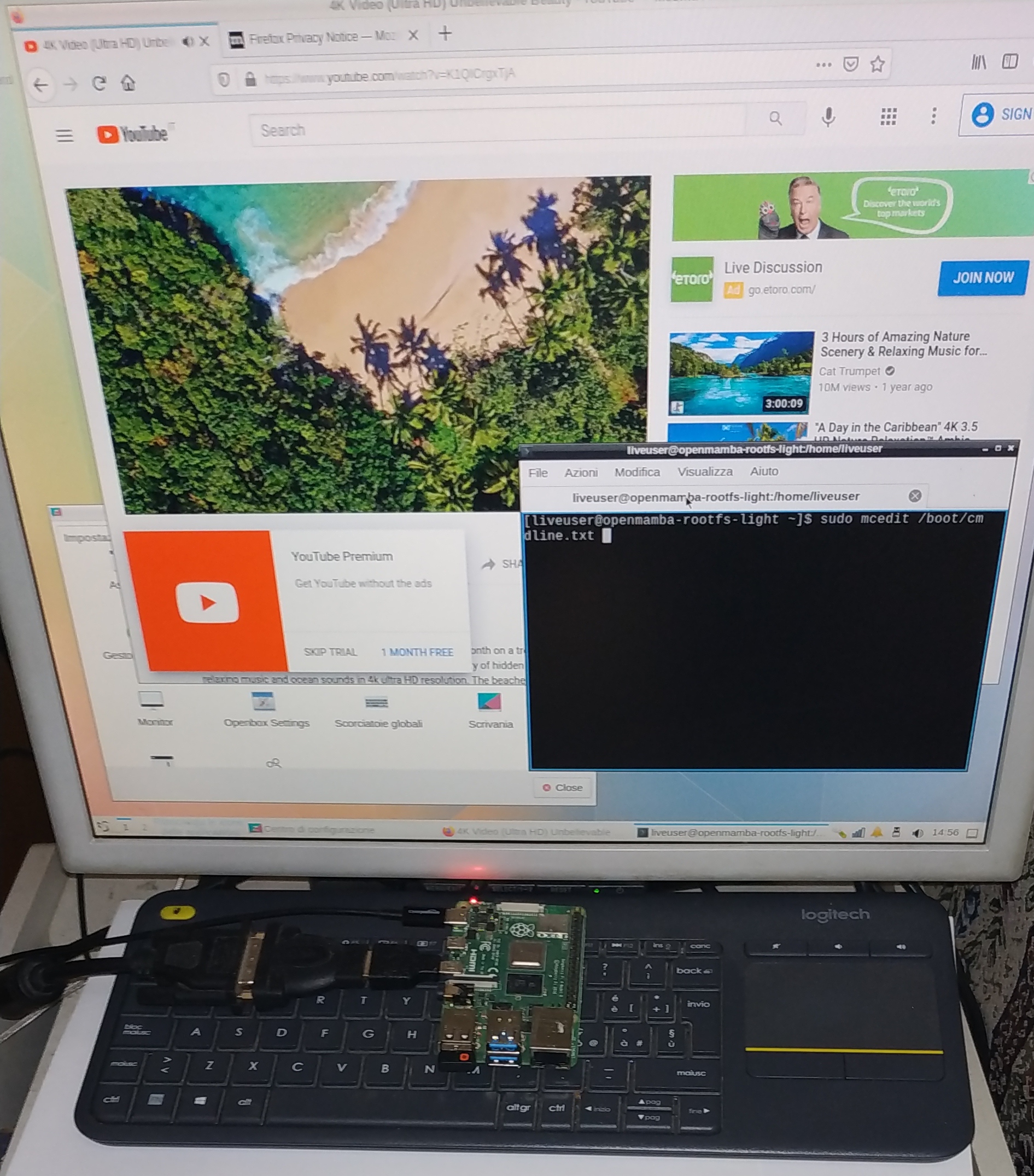
The openmamba Raspberry Pi support has been significantly reworked. Raspberry Pi images now use the openmamba vanilla Linux kernel (currently 6.18.x) instead of the Raspberry Pi-patched kernel used previously. This approach ensures timely kernel updates on a par with other architectures and greater consistency with upstream kernel development.

The raspberrypi-firmware package now provides only GPU bootloader files (start*.elf, fixup*.dat, bootcode.bin) and overlays, while the kernel comes from the standard openmamba kernel package for aarch64. Device Tree Blobs (DTBs) for the various Pi models are included directly in the vanilla kernel via the dts/broadcom directory. A new rpi-prepare-boot script handles the preparation of the FAT32 boot partition, automatically assembling the kernel, initramfs (generated by dracut), DTBs and firmware files.

Thanks to the DTBs included in the vanilla kernel, theoretical support now extends to Raspberry Pi 3, 4 and 5 (including Compute Module and Zero 2 variants). Support for Pi 3 and Pi 5 should be considered experimental, and user feedback is very welcome.

Additional improvements: WiFi correctly configured via blacklist and modules-load, udev rule for Bluetooth, CMA memory set to 256 MB in cmdline.txt (required by applications such as Firefox).

Two image variants are available for download from the download page:

  • diskimg-raspberrypi rolling (LXQt, aarch64, 2.7 GB — March 23, 2026) — lightweight environment, recommended for Pi 3 and Pi 4 with limited RAM
  • diskimg-raspberrypi-plasma rolling (KDE Plasma, aarch64, 3.2 GB — March 24, 2026) — full KDE Plasma environment, recommended for Pi 4 and Pi 5 with 4+ GB of RAM

Minimum requirements: 16 GB SD card. User feedback is particularly welcome for Pi 3 and Pi 5.

openmamba API and internal tools

api.openmamba.org is now available: a new public REST API for querying the openmamba repositories — package search, dependency lookup, changelogs and much more. The OpenAPI 3.0 specification is available at api.openmamba.org/openapi.json. These APIs power the new Packages section on openmamba.org, which now offers more complete and up-to-date browsing and search than before, and support the internal distribution development and management workflows.

The internal build system tools have also been updated: autodist 2.0.5 (new major version), distromatic 3.0.4 (new major version) and autospec 1.44.

Installation media

Updated rolling installation media are available from the download page.

  • livecd rolling (x86_64, 2.6 GB — April 6, 2026) — KDE Plasma desktop with essential applications
  • livedvd rolling (x86_64, 3.6 GB — April 9, 2026) — KDE Plasma desktop with a full software suite
  • livecd-light rolling (x86_64 2.4 GB and i586 2.1 GB — April 10, 2026) — LXQt desktop for resource-constrained systems
  • rootfs rolling (x86_64 and aarch64 — April 22, 2026) — base filesystem for advanced installations
  • rootfs-base rolling (x86_64, aarch64, i586 — April 5, 2026) — minimal system for experts and developers

Docker images on Docker Hub for x86_64, aarch64 and i586 have also been updated.

What’s new in openmamba — February/March 2026

Starting this month, openmamba is making use of artificial intelligence tools to support some maintenance activities: monitoring upstream updates, creating new packages, drafting communications such as this announcement, and other infrastructure-related tasks. The entire process remains coordinated and supervised by Silvan Calarco, the creator and sole (human) maintainer of the distribution.

KDE Plasma 6.6.2

Maintenance update for KDE Plasma 6.6.2, openmamba’s main desktop environment, bringing bug fixes and stability improvements. All core components are included: plasma-workspace, plasma-desktop, plasma-nm (networking), plasma-pa (audio), plasma-systemmonitor, plasma-firewall, plasma-vault, plasma-browser-integration and many more.

KDE Frameworks 6.23.0

KDE Frameworks 6.23.0 updates the set of foundational libraries on which all KDE applications are built, with improvements and fixes across more than 70 modules. Also notable is Kirigami 6.23.1, the UI framework for convergent desktop/mobile applications.

KDE Gear 25.12.3

The largest update batch this month is the KDE Gear 25.12.3 suite, bringing bug fixes and stability improvements across the entire KDE application ecosystem. Over 150 applications are involved, including:

  • Dolphin (file manager), Kate (text editor), Konsole (terminal)
  • Okular (document viewer), Gwenview (image viewer), Ark (archive manager)
  • Kdenlive (video editor), Kwave (audio editor), K3b (CD/DVD burner)
  • KMail / Kontact / KOrganizer / KAddressBook (full PIM suite)
  • Kleopatra / KGpg (GPG key and certificate management)
  • KDEConnect (Android/iOS device integration)
  • Elisa (music), Dragon (video), PlasmaTube (YouTube), AudioTube (YouTube Music)
  • NeoChat (Matrix), Tokodon (Mastodon), Konversation (IRC)
  • Calligra (office suite), GhostWriter (Markdown editor), Arianna (ebook reader)
  • Merkuro (calendar), KBackup (backup), Filelight (disk usage)
  • Itinerary / KTrip (travel and public transport), Kasts (podcasts)
  • IsoimageWriter (write ISO images to USB), Keysmith (2FA token generator)

Security

  • ClamAV 1.5.2 — open source antivirus update with new signatures and security fixes
  • Tailscale 1.96.0 — WireGuard-based VPN with two-factor authentication
  • iptables 1.8.13 — essential Linux firewall configuration tool
  • OpenVAS Scanner 23.40.5 / GVM-libs 22.36.0 — Greenbone professional vulnerability assessment suite

System

  • systemd 259.3 — system and service manager update
  • e2fsprogs 1.47.4 — ext2/3/4 filesystem utilities
  • nfs-utils 2.8.6 — updated NFS client and server support
  • Postfix 3.11.0 — new major release of the mail transfer agent
  • Memcached 1.6.41 — high-performance distributed in-memory caching system
  • Fastfetch 2.60.0 — fast system information tool (modern neofetch alternative)
  • Conky 1.22.3 — lightweight desktop system monitor
  • snapd 2.74.1 — Snap package support

Communication and Internet

  • Signal Desktop 8.1.0 — desktop client for the popular end-to-end encrypted messaging service
  • Brave 1.87.192 — Chromium-based browser with built-in ad and tracker blocking
  • Evolution 3.58.3 — GNOME mail, contacts and calendar client
  • Rclone 1.73.2 — cloud storage sync tool (Google Drive, S3, Dropbox and many more)
  • Streamlink 8.2.1 — stream video from various services into your preferred local player

Multimedia

  • GStreamer Bad Plugins 1.28.1 — update to the extended GStreamer plugin set
  • OpenEXR 3.4.6 — HDR image format for professional computer graphics
  • dcadec 0.2.0 — DTS Coherent Acoustics decoder with HD extensions support
  • ncpamixer 1.3.11 — terminal audio mixer for PulseAudio

Development

  • Rust (rustc) 1.94.0 — Rust compiler update
  • Go 1.26.1 — new major release of the Go programming language
  • NASM 3.01 — new major release of the x86 assembler with Intel syntax
  • fish 4.5.0 — new major release of the user-friendly interactive shell
  • git-lfs 3.7.1 — Git extension for versioning large files
  • ccache 4.13 — compiler cache to speed up recompilation
  • docker-buildx 0.32.1 — Docker CLI plugin for advanced builds with BuildKit
  • pnpm 10.31.0 / yarn 4.13.0 — updated Node.js package managers
  • apache-maven 3.9.13 — project management tool for Java projects
  • Vim 9.2.0112 — update to the classic text editor

Graphics and Creativity

  • Glaxnimate 0.6.0 — vector animation editor (Lottie/SVG format)
  • Gobby 0.6.0 — real-time collaborative text editor
  • PCB 4.3.0 — printed circuit board design editor

openmamba Internal Tools

  • autodist 1.8.2 and distromatic 2.5.0 — updates to the build system and repository management tools

Installation Media

Updated openmamba rolling installation media are available. They can be downloaded from the download page.

  • livecd rolling (x86_64, 2.6 GB — March 6, 2026) — KDE Plasma desktop with basic software
  • livedvd rolling (x86_64, 3.6 GB — March 7, 2026) — KDE Plasma desktop with full software suite
  • livecd-light rolling (x86_64 and i586, 2.4/2.1 GB — March 9, 2026) — lightweight LXQt desktop for low-resource systems
  • rootfs-base rolling — base system tar.xz archive, available for x86_64, aarch64 and i586

The Docker images on Docker Hub have also been updated for x86_64, aarch64 and i586 architectures.

News: openmamba ready to ship KDE Plasma 6 “mega-release”

After a period of packaging and testing openmamba is ready to ship the KDE Plasma 6 mega release upgrade to all users.

The next snapshots of livecd and livedvd live and installation media, which will be available within a couple of days, will already be provided with KDE Plasma 6.

In a few days the KDE Plasma 6 upgrade will be made available also to current installations of the openmamba rolling O.S. since several tests have shown that the upgrade process should be smooth for everybody.

After receiving and applying the upgrade the system needs to be rebooted. In some uncommon cases rebooting using the normal interface from the Plasma menu might not work, if you encounter this problem we suggest to close all running applications and issue a “sudo reboot” command from a terminal window.

Users using the default Plasma session will be automatically switched from X11 to Wayland graphical backend, which is now the default and recommended type of desktop session to use with KDE Plasma and openmamba.

Users can anticipate the upgrade by temporary enabling the “openmamba miscellaneous packages repository [unstable]” in discover Settings.

If you encounter any problem you may use the forum or the other openmamba support channels to ask for help.

Enjoy!

New: Git-based source repository and other news

openmamba provides a new web service on the src.openmamba.org site where the recipes (.spec files), patches and additional files representing the over 5500 source packages with which the distribution in format is created and maintained are easily consultable. tracks. The service, based on the Gitea platform, in addition to the RPMs also hosts openmamba’s internal projects.

Other activities completed in 2023:

  • the obsolete arm architecture (armel soft-fp) was abandoned to concentrate current and future developments on the two main architectures x86_64 and aarch64; the i586 (x86 32bit) architecture is still maintained in particular to provide the compatibility subsystem for 32-bit applications on installations for x86_64, used for example for Wine and the Steam video games platform;
  • last September the migration to a flat root filesystem hierarchy was completed, i.e. eliminating duplicates of the *bin and lib* folders in the root folder (/) and in /usr; this operation has caused some problems in the updates in various phases, however leading to greater maintainability and future stability of the systems successfully updated or installed from scratch after September 2023;
  • the constant maintenance and development by the sole maintainer in recent years has brought the distribution to an update level between 85 and 90% (repology) with stability, security and modernity benefits found on the Plasma and LXQt desktop targets;
  • the main repository of the rolling distribution has been renamed from devel to base.

In the next future:

  • the KDE Plasma environment will need to be updated to be based on Qt6 following the upstream schedule;
  • the new package management on src.openmamba.org opens up renewed possibilities for collaborative development also considering that the platform provides functionality for each package for reporting problems, for drafting documentation in Wiki format and for managing Pull Requests; the currently centralized development mechanisms based on the webbuild interface and the autospec and autodist layers could be enhanced using tools such as tito and mock; at the moment there are no precise plans and these developments will depend on any interest and availability found.

Happy 2024 wishes.

Silvan


News: support for 64-bit ARM architecture (and Raspberry Pi 4)

openmamba is now available for the aarch64 (aka arm64) architecture, which is added to the x86_64, i586 e arm (armel) supported architectures.

This makes openmamba potentially compatible with present and future devices based on 64-bit ARM architecture that have a standard GNU/Linux kernel.

At the same time the openmamba rolling diskimg-raspberrypi for aarch64 image file is available for download, ready to be flashed on a microSD and used with a Raspberry Pi 4 (and technically also with Raspberry Pi 3). The image provides the LXQt desktop environment with support for automatic partition resizing on first boot. Production of the image file that the KDE Plasma environment provides will follow shortly.

Advanced users can use the rootfs-base and rootfs-light for aarch64 images (and soon rootfs) by installing a suitable kernel to run all variants of openmamba on other 64-bit ARM-based devices.

The porting of the applications is still in progress and I invite users to write in the forum in case you need that particular applications are made available for aarch64 with higher priority.

Silvan

openmamba “light” with LXQt desktop

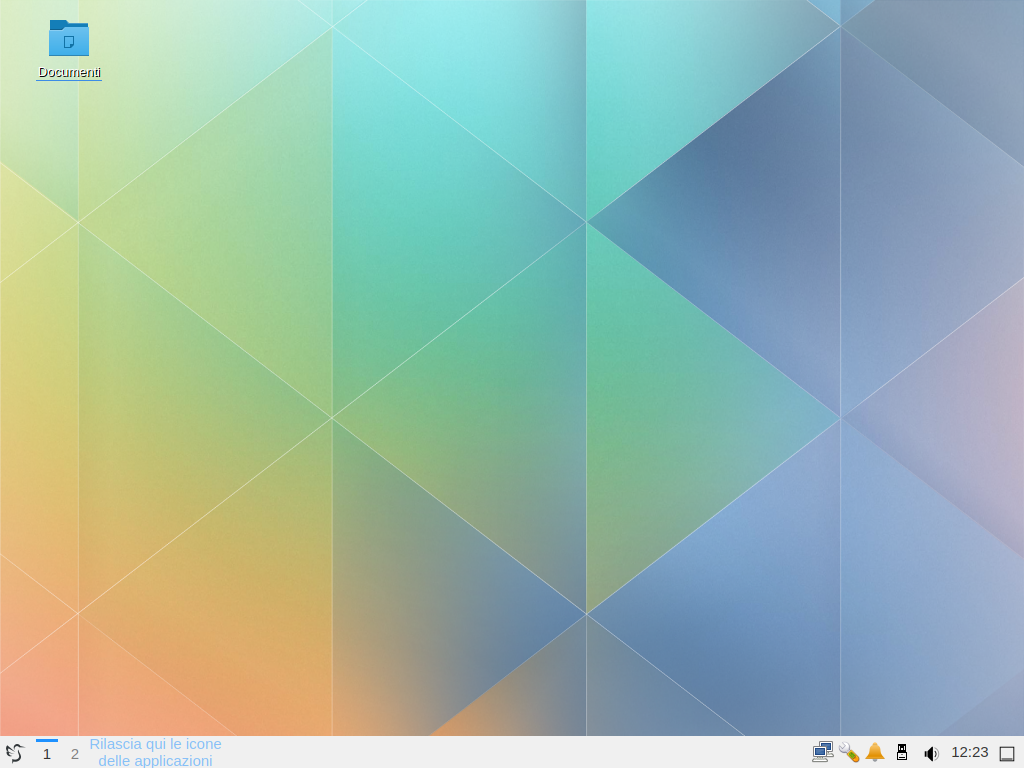
The “light” version of openmamba is renewed by adopting the LXQt desktop environment which replaces the previous LXDE environment.

Meanwhile, the main release continues to provide users with an always up-to-date KDE Plasma desktop environment.

In the Downloads section all the supports are available to run in live mode and install openmamba on PCs (64 and 32 bit x86 compatible archs):

openmamba livecd rolling – ISO for live execution and installation of openmamba with KDE Plasma environment

openmamba livecd-light rolling – ISO for live execution and installation of openmamba with LXQt environment

openmamba livedvd rolling – ISO image recommended for installations in languages ​​other than Italian and English

In the Download section other formats are also available to allow direct installation on USB key (diskimg), manual (rootfs) and for RaspberryPi.

openmamba: subsystem updated to RPM 4 and DNF

After a period of development and testing, the openmamba software packages management and update subsystem has been updated and rebased on version 4 of the RPM manger package using DNF (which replaces YUM) for managing system updates.

With this important change openmamba aligns with the main distributions of the Linux o.s. based on RPM implementing a convergent and maintained solution and thus overcoming some problems, among which the main for the user was the impossibility of making updates using applets and graphical desktop interfaces.

Current installations will be updated to the new subsystem by running (for the last time) the `sudo yum update` command from the terminal. In case of problems after the update, I invite you to write or search for information in the openmamba website forum.

Live and installation media will be available with the new subsystem as they are automatically regenerated, ie with a date equal to or later than 07/21/2019.

openmamba makes available to anyone interested a desktop operating system based on the most recent versions of KDE Plasma and the main applications trying to provide an experience that is always in step with the times. With the news announced today, the prospect for the near future is that openmamba can improve further and faster.

Silvan

openmamba returns to have a single maintainer

From this year the maintenance and development of openmamba have resumed a pace equal if not higher than in previous years. Working with continuity I have producted a substantial modernization of the package base of the rolling version of the distribution and updated and verified the media for installation and live use (livedvd, livecd, etc.).

Seen my renewed possibilities to return to work on openmamba with continuity and focus and having ideas to make improvements in the present and near future, I asked to be able to resume the complete management of the project and overcome the current management divided between coordinators of the areas of communication, development, documentation and testing and graphics. The coordinators have welcomed my will by renewing their willingness to collaborate and contribute to the project as much as they can.

First of all I would like to thank Andrea Martina for starting the #restart process of openmamba after a difficult transition at the beginning of 2017 that had led the undersigned to announce the closure of the project.

Thanks to Ercole Carpanetto and Federico Bottero for making themselves available and participating as coordinators and to all those who have given their support in any way demonstrating their interest in this project.

The activities currently will continue on the development and improvement of the rolling version of openmamba.

See you soon,
Silvan Calarco

#RESTART OPENMAMBA!

The openmamba project, after the previous announcement, is back up and under development.

Thanks to the interest of many users it was possible to restart reviewing its organization and development processes.

Now, under the expert guide of the team leader Silvan Calarco, four work groups have been constituted: communication and promotion, testing and documentation, technical development and graphical contents.

Each area has its own coordinator which is responsible to organize the work with people who want to collaborate.

This new management will allow to make plans for the future while maintaining the project peculiarities on stability, simplicity and independence.

This is only a first step: openmamba is a singular project in the italian scene of GNU/Linux distributions, exclusively based on the commitment of voluntary people and in order to grow up more it needs new users willing to use, test and take part to the project. This is why we will be pleased to welcome new forces.

We want to say thanks to all the people who made themselves available so that all this happened.

Silvan Calarco
Ercole Carpanetto
Federico Gottero
Andrea Martina

*** openmamba END OF LIFE announcement ***

The openmamba project officially closes after ten years of life.

Website, services and repositories will continue to be available for an indeterminate period.

The maintainer and founder of the project wishes to thank all the people that in the years have supported and believed in this project.

S.C.