


This month the openmamba.org website gets a new look, and the distribution’s build management moves to a new infrastructure with a completely redesigned web interface. KDE Plasma 6.8, now Wayland-only, has landed in the base repository together with KDE Gear 26.08.3 and LXQt 2.5. Work is under way to provide automatic snapshots and updates with rollback on btrfs installations starting with the next ISOs, and the system moves to OpenSSL 4. Highlights among the updates include Firefox and Thunderbird 160, Blender 5.3, LibreOffice 26.8.3 and KeePassXC 2.8.
The new openmamba.org website
The website has been redesigned from scratch with a lighter, more modern theme that automatically follows the system’s light or dark mode and is designed for smartphones too. What’s new:
- Home page with new desktop screenshots and a clearer presentation of the distribution’s features
- Downloads page reorganized as a single table that can be filtered by architecture
- Package pages more compact and readable on small screens too, with the architecture filter on the same row as the search field
- Forum integrated into the website’s design, in both light and dark mode
- Unified search that also returns packages and forum topics
- Simpler, consistent forms for login, registration and comments
New development infrastructure: autodistd and the web frontend
The old webbuild panel has been replaced by a new infrastructure. Every build host (x86_64, i586, aarch64 and the one dedicated to mass rebuilds) now runs autodistd, a service that exposes the state of the build queues, scheduling and logs through an API, publicly reachable at https://api.openmamba.org/autodistd. A new web frontend has been built on top of this API and is available on the website’s autodist page:
- Build platform dashboard, with the live build queue, the outcome of each package and logs viewable right in the page
- Repository maintenance view, to import packages into the base repository, archive them or rebuild their dependents
- Web spec file editor, with patch and source management, package build and upload, a build directory browser and creation of new packages from a source URL
- Repository statistics and a live log of development activity
- Installable as a web app on smartphones and desktops
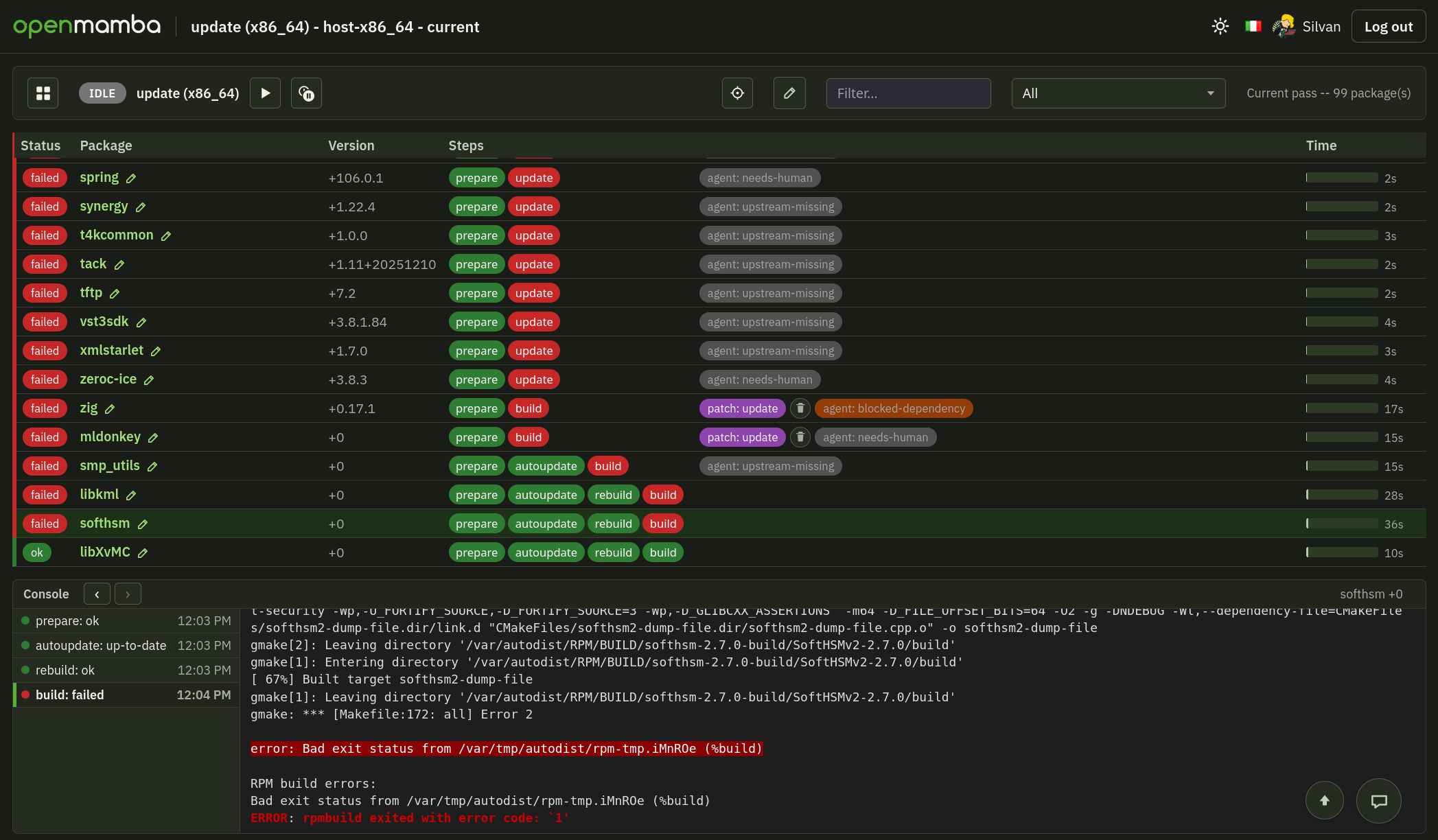
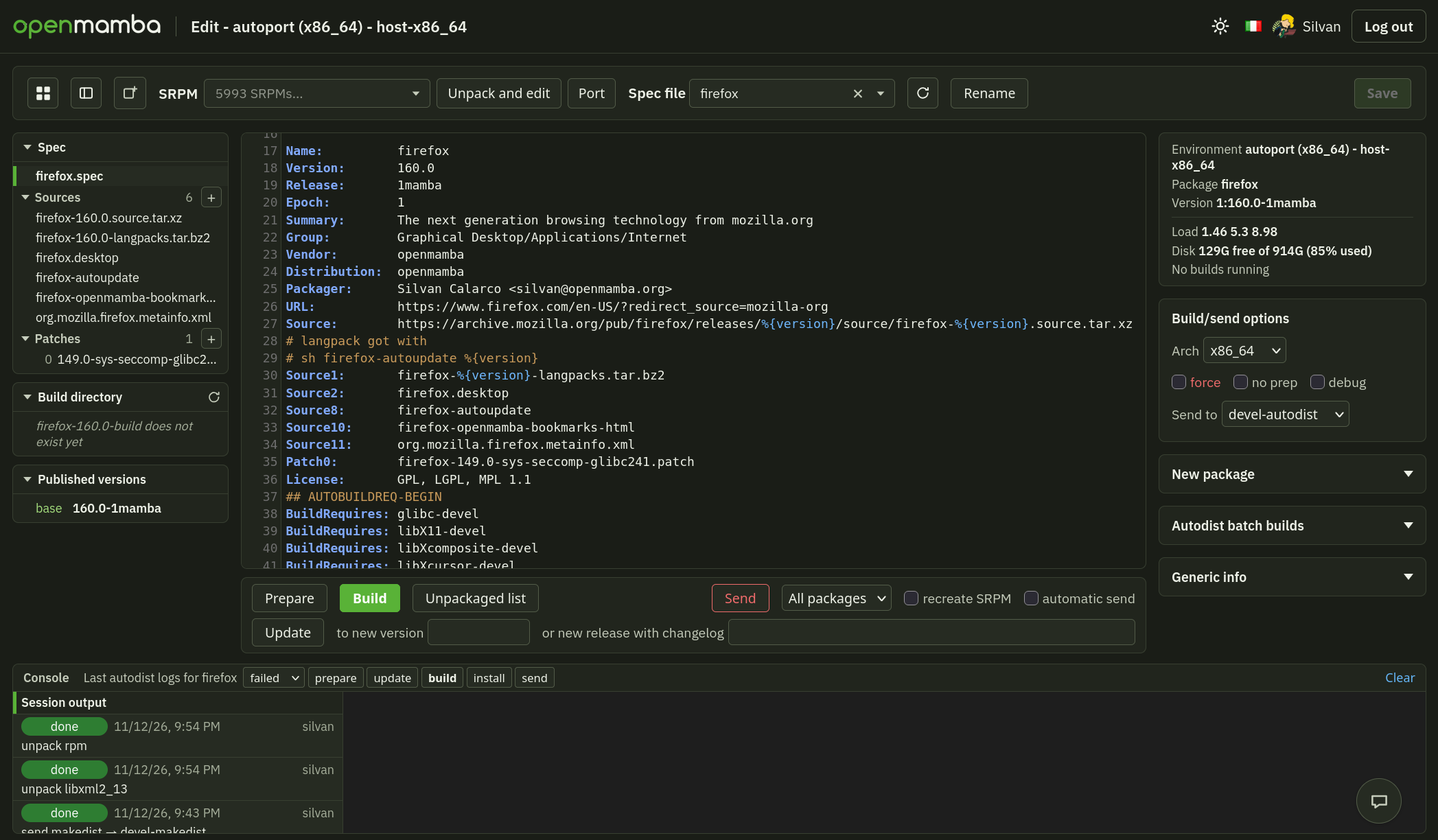
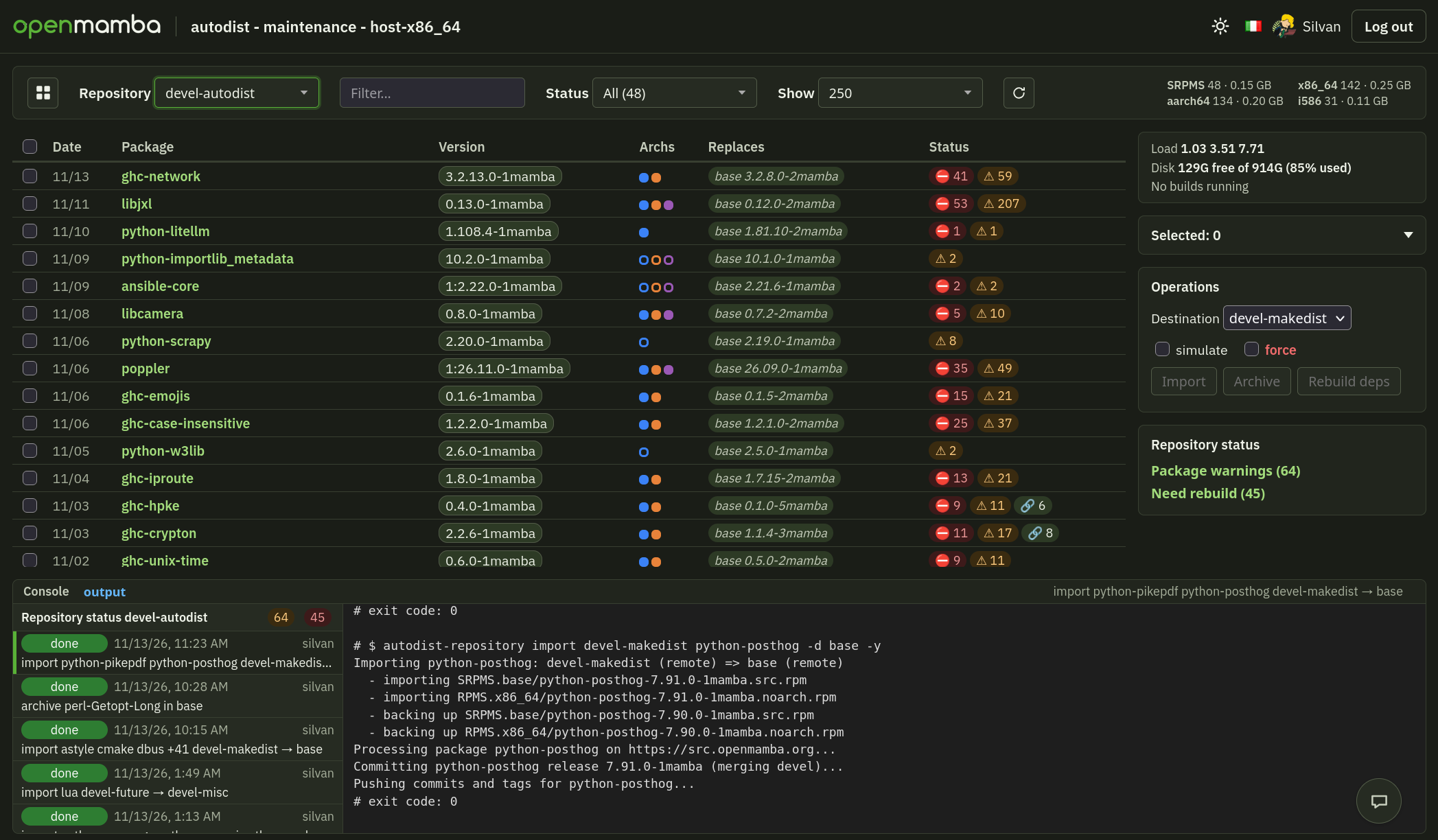
Browsing is open to everyone; build and maintenance operations are reserved for developers enabled on each platform or repository.
New packages in the base repository
- 0 A.D. 0.28.0 — historical 3D real-time strategy game
- CadCraft 0.19.0, FilmCraft 0.18.0 and SoundCraft 0.18.0 — free applications written in Rust, from the same family as PhotoCraft, for CAD drafting, video editing and audio production
- Btrfs Assistant 3.0.0 — graphical tool to manage btrfs filesystems and Snapper snapshots
- grub-btrfs 4.14 — GRUB boot entries for btrfs snapshots
- Neovim 0.12.6 — Vim-based editor focused on extensibility
- Contour 0.8.0 — modern GPU-accelerated terminal emulator
- SoundConverter 4.1.3 — simple audio file converter
- bspwm 0.9.12 and sxhkd 0.6.3 — tiling window manager and hotkey daemon
- xdotool — keyboard, mouse and window automation for X11
- grim and slurp — screenshots and region selection for Wayland compositors
- inotify-tools 4.26 — command line tools to watch for file changes
- Fauxmo 0.8.0 — emulated Belkin WeMo devices controllable from Amazon Echo
KDE Plasma 6.8 and KDE Gear 26.08.3
KDE Plasma 6.8.3 is now in the base repository: as announced last month, it is the first version available only with a Wayland session, while X11 applications keep working through XWayland. The update removed the X11-specific packages and brought Kup, the backup tool integrated into Plasma, and Plasma Bigscreen, the interface for TVs and set-top boxes. KDE Gear applications, including Dolphin, Kate, Konsole, Okular, Gwenview, Kdenlive and KMail, are updated to 26.08.3. Discover no longer shows some applications as system packages without an icon in the updates page, and the KScreen on-screen display now appears on the primary monitor when there is no built-in panel.
LXQt 2.5
LXQt moves to version 2.5. The LXQt session now correctly activates systemd’s graphical session services with any compositor, and the new xdg-desktop-portal-lxqt and xdg-desktop-portal-wlr packages provide desktop portals (file chooser, screen sharing and screenshots) on Wayland too, for example with labwc. The NetworkManager applet now also shows up in system trays on Wayland.
System snapshots and restore with btrfs
Work is under way to introduce, starting with the next ISO images, system snapshot management and updates with rollback. The required components are already in the base repository. When btrfs is chosen during installation, the installer will automatically set up Snapper with a dedicated snapshot subvolume. From then on:
- every package installation or update, from
dnfas well as from Discover, will create a snapshot before and after the change - snapshots will appear in the GRUB boot menu thanks to grub-btrfs, and can be booted to go back to a previous state of the system
- when booting a snapshot, mambatray will point this out and offer to make it the default system at the next reboot
- Btrfs Assistant, also reachable from the mambatray menu, will let you browse and restore snapshots from a graphical interface
In the future btrfs will become the default filesystem for installation, while it will always be possible to choose ext4 for a classic installation without snapshots. The mambabase welcome program now lets you expand software groups and pick individual packages, installing them all in a single operation.
OpenSSL 4
The system has moved to OpenSSL 4.1, with all dependent packages rebuilt. For third-party applications that still need the previous version, the libopenssl3 package (3.5 LTS series) is available and can be installed alongside the new version. OpenSSL’s Perl scripts have been moved to the separate openssl-perl package.
Important fixes
- GRUB 2.16: fixed an issue that prevented the kernel from loading from btrfs partitions;
grub-installnow also removes EFI boot entries left over from previous installations on partitions that no longer exist, which prevented the new one from being created - OpenEXR: fixed a crash at startup on processors without AVX-512 instructions, affecting applications that read EXR images
- LibreOffice: the user interface language, which in some cases was not installed, has been restored
- Flatpak: fixed an error while updating applications
- Postfix no longer uses Berkeley DB: tables are automatically converted to the LMDB format during the upgrade
- Apache:
mod_rewriteis enabled by default; the WordPress, Drupal, Joomla and Matomo configurations have been updated; Roundcube no longer depends on Apache and follows the standard directory layout - rpcbind: on new installations the required system user was missing and the service failed at every boot
- lm_sensors: its services no longer fail at boot until the sensors are configured
- Mono: fixed the
cert-syncerror during installation - Contour: fixed a crash at startup
Main updates
- kernel 6.18.63 — Linux kernel stability and security updates
- systemd 262.2 — init system and service manager
- Mesa 26.2.7, LLVM 23.1.5 and NVIDIA 620.70.06 driver — updated graphics stack and compiler
- Firefox 160.0 and Thunderbird 160.0 — Mozilla browser and email client
- Chromium 156 and Brave 1.99.57 — Chromium-based browsers
- LibreOffice 26.8.3.1 — office suite
- Blender 5.3.0 — 3D modeling, animation and rendering
- GIMP 3.2.8, G’MIC 4.0.7, ImageMagick 7.1.2.35 and Scribus 1.6.7 — graphics and desktop publishing
- Audacity 4.0.2, Ardour 9.10 and Rakarrack 1.4.1 — audio; Rakarrack switches to the actively developed rakarrack-plus fork
- OBS Studio 33.0.1, mpv 0.42.0 and GStreamer 1.28.9 — multimedia recording and playback
- KeePassXC 2.8.0 — password manager
- Telegram 7.4.2 and Signal Desktop 8.35.0 — messaging clients
- qBittorrent 5.3.0 and Transmission 4.1.4 — BitTorrent clients
- KiCad 10.0.8 and Calibre 9.18.0 — electronic design and ebook management
- Hyprland 0.57.2 — tiling Wayland compositor
- Rust 1.100.0, Go 1.27.4, CMake 4.5.0, Node.js 26.13.1, Perl 5.44, Ruby 4.0.9, Tk 9.1 and Git 2.56.1 — development toolchains and languages
- Boost 1.92 and ICU 79 — older versions removed, with dependent packages rebuilt
- QEMU 11.1.3, libvirt 12.9.0 and Docker 29.9.3 — virtualization and containers
- PostgreSQL 18.7, Nextcloud 35.0.3 and Apache 2.4.71 — database, collaboration and web server
- Samba 4.25.1, OpenSSH 10.6p2, OpenVPN 2.7.9, Tailscale 1.104.7 and rclone 1.76.0 — networking, VPN and sync
- BlueZ 5.88 and PipeWire 1.6.11 — Bluetooth and audio
Minimal installations and the i586 architecture
systemd is no longer a hard requirement of base packages such as glibc, PAM, util-linux and dnf, and libxml2 no longer depends on ICU: this is the first step towards minimal installations, such as the rootfs-base image and Docker containers, that do without systemd and the ICU libraries. The i586 architecture is now limited to 32-bit compatibility libraries, needed for example by Wine and Steam, and no longer provides a desktop environment: Firefox has been removed from the i586 repository and the rootfs-light image is no longer built for this architecture. rootfs-base remains available for i586, used for Docker containers and build systems.
Internal tools
Besides the new infrastructure described above, autodist 2.4.22, autospec 1.60 and distromatic 3.3.18 have been updated. The openmamba API (documentation) now also offers browsing of the files contained in packages, repository statistics and the list of dependent packages. makedist 3.0, the tool that produces the installation media, now installs packages with dnf, resolving dependencies automatically. Perl now provides ABI compatibility information for compiled modules, making future version upgrades easier.
Installation media
Images can be downloaded from the downloads page.
- livecd rolling (x86_64, 2.4 GB — October 21, 2026) — KDE Plasma desktop with essential applications
- livedvd rolling (x86_64, 3.3 GB — October 24, 2026) — KDE Plasma desktop with a full software suite
- livecd-light rolling (x86_64, 2.1 GB — October 16, 2026) — LXQt desktop for systems with limited resources
- diskimg-livecd rolling (x86_64, 2.4 GB — November 8, 2026) — live system to write to a USB stick
- diskimg-raspberrypi rolling (LXQt, aarch64, 2.3 GB — November 8, 2026) — Raspberry Pi image with a lightweight desktop
- diskimg-raspberrypi-plasma rolling (KDE Plasma, aarch64, 2.2 GB — November 10, 2026) — Raspberry Pi image with KDE Plasma
- rootfs rolling (x86_64 1.9 GB, aarch64 1.8 GB — October 5, 2026) — base filesystem for advanced installations
- rootfs-light rolling (x86_64 1.7 GB, aarch64 1.6 GB — November 6, 2026) — lighter filesystem, a slimmer alternative to rootfs
- rootfs-base rolling (x86_64 102 MB, aarch64 95 MB, i586 102 MB — October 22, 2026) — minimal system for experts and developers
Leave a Reply
You must be logged in to post a comment.